Intercom and Gladly both aim to transform customer service, but they approach the problem differently. Intercom is an AI-first customer service platform built around Fin AI Agent and a modern helpdesk. Gladly is a people-centric CX platform that organizes every interaction into a single, lifelong conversation per customer, purpose-built for B2C retail and DTC brands.
This guide compares them across seven dimensions: architecture, AI capabilities, pricing, channels, integrations, target market, and where each platform genuinely excels.
Architecture: tickets vs. conversations vs. AI-first
The biggest difference between Intercom and Gladly is how each platform organizes customer interactions.
Gladly replaces traditional ticketing with what it calls a "people-not-tickets" model. Every email, chat, call, and SMS from a single customer lives in one continuous thread that persists across channels and over time. Agents see the full history without switching between separate tickets. This architecture is genuinely differentiated and works well for B2C brands where repeat customers contact support frequently.
Intercom takes an AI-first approach. Rather than simply organizing conversations for human agents, Intercom is designed so that Fin AI Agent resolves the majority of customer queries autonomously before they reach a human. When escalation is needed, the Intercom helpdesk provides a shared inbox, ticketing, SLA management, workflows, and a knowledge hub in one connected system. The AI and helpdesk share data, context, and reporting natively.
The practical difference: Gladly optimizes the human agent's workflow. Intercom optimizes for resolution before a human agent is needed at all.
AI capabilities: Fin AI Agent vs. Gladly Sidekick
Both platforms offer AI-powered resolution, but the depth of investment and published performance data differ significantly.
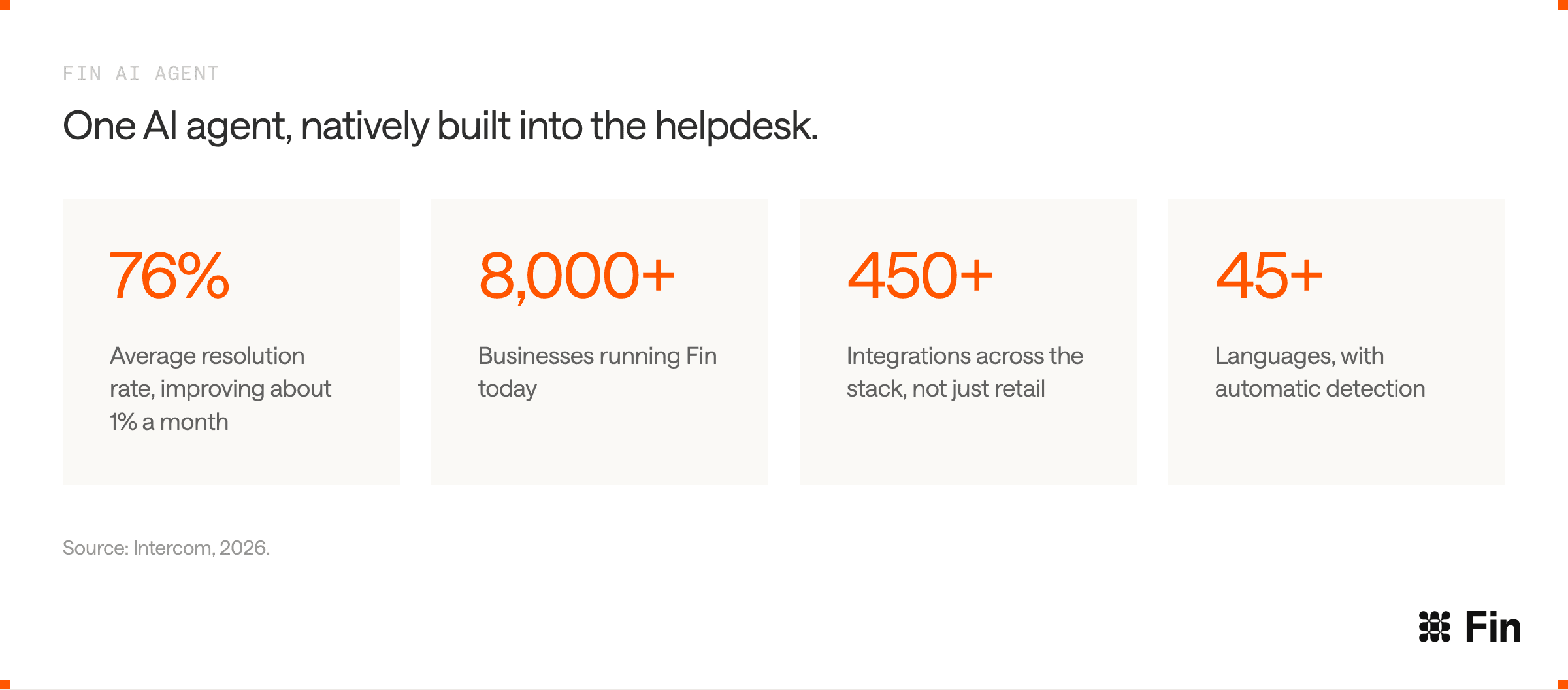
Fin AI Agent is powered by the Fin AI Engine, a proprietary, purpose-built architecture that includes custom-trained models (fin-cx-retrieval and fin-cx-reranker), multi-step reasoning, and validation layers designed specifically for customer service. Fin averages a 76% resolution rate across 12,000+ customers and handles complex, multi-step queries through Procedures, which combine natural language instructions with deterministic controls. Fin operates across every major channel, including voice, email, live chat, WhatsApp, social, Slack, and SMS. Teams configure, test, and iterate on Fin themselves through the Fin Flywheel: Train, Test, Deploy, Analyze.
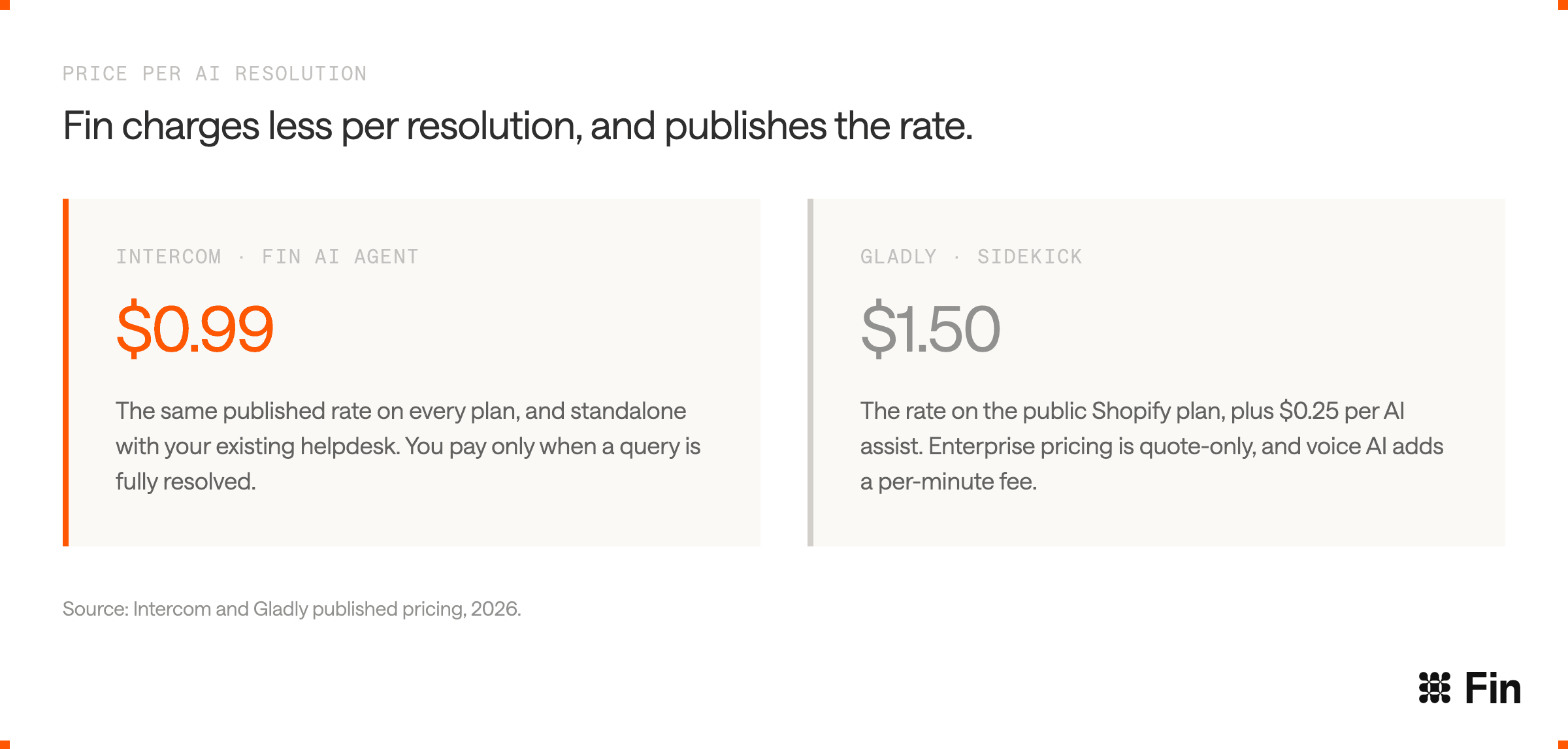
Fin is priced at $0.99 per resolution. You only pay when a customer's issue is actually resolved.
Gladly Sidekick is Gladly's AI agent, branded as "Gladly AI" following a recent naming update. It resolves queries across chat, email, voice, SMS, and social, and can take actions like canceling orders or initiating returns. Gladly claims a 76% AI resolution rate across its customer base, with documented outcomes including 3x resolution rate increases in the first 30 days and 2.2x revenue per conversation for specific customers. Sidekick uses "Guides" to configure AI behavior, which are broadly comparable to Intercom's Procedures.
Gladly's AI pricing on its public Shopify plan is $1.50 per AI resolution plus $120 per agent seat per month. Enterprise pricing is quote-only and typically lands between $180 and $210 per agent per month based on third-party reports, with additional per-minute charges for voice AI.
| Dimension | Intercom (Fin AI Agent) | Gladly (Sidekick / Gladly AI) |
|---|---|---|
| Published resolution rate | 76% average across 12,000+ customers | 76% claimed; specific customers report 59%-75% |
| AI pricing | $0.99 per resolution | $1.50 per AI resolution (Shopify plan); enterprise quote-only |
| Proprietary AI models | Yes (fin-cx-retrieval, fin-cx-reranker, Fin Apex 1.0) | Not disclosed |
| Complex workflow handling | Procedures with deterministic controls + natural language | Guides with action-based configuration |
| AI testing framework | Simulations, Simulation Library, batch testing, previews | Not publicly documented at comparable depth |
| Continuous improvement | Fin Flywheel (Train, Test, Deploy, Analyze), AI Suggestions, CX Score | Improvement Opportunities dashboard, Guide optimization |
| Languages | 45+ | Not consistently disclosed; third-party sources note limited multilingual support |
| Self-serve configuration | Yes, non-technical teams own iteration | Guides are manageable by CX teams; enterprise configuration may require vendor support |
Pricing: transparent vs. quote-based
Pricing is one of the starkest differences between the two platforms.
Intercom publishes its pricing openly. The helpdesk starts at $29 per seat per month (Essential), $85 (Advanced), and $132 (Expert). Fin AI Agent costs $0.99 per resolution on top, charged only when a query is fully resolved. Fin can also be deployed as a standalone AI agent with any existing helpdesk at $0.99 per resolution with unlimited seats included.
Gladly does not publish enterprise pricing. Third-party sources consistently report $180 to $210 per agent per month for the Hero and Superhero tiers, with minimum seat requirements of 10 and 45 seats respectively. Gladly's Shopify plan is the only publicly priced option: $1.50 per AI resolution, $0.25 per AI assist, and $120 per seat per month. Voice AI carries an additional per-minute fee.
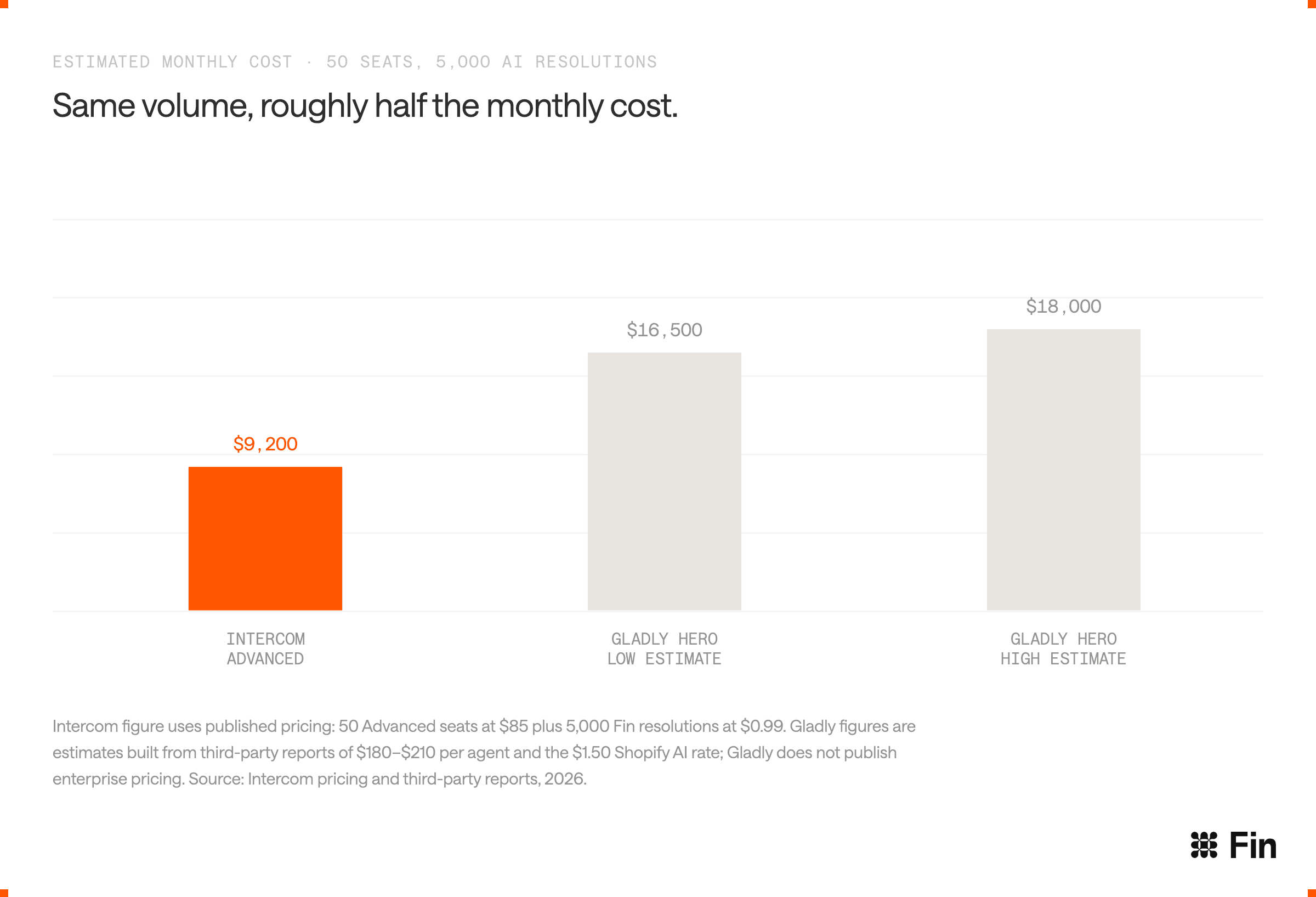
For a 50-seat team handling 5,000 AI resolutions per month:
| Cost component | Intercom (Advanced) | Gladly (estimated Hero tier) |
|---|---|---|
| Platform seats | $4,250/mo (50 × $85) | ~$9,000-$10,500/mo (50 × $180-$210) |
| AI resolutions | $4,950/mo (5,000 × $0.99) | ~$7,500/mo (5,000 × $1.50, Shopify rate) |
| Estimated monthly total | ~$9,200 | ~$16,500-$18,000 |
| Estimated annual total | ~$110,400 | ~$198,000-$216,000 |
Gladly's enterprise AI resolution pricing may differ from the public Shopify rate and is only available through a sales conversation. Intercom's pricing is the same whether you sign up online or talk to sales.
Channels and omnichannel coverage
Both platforms support voice, email, chat, SMS, and social messaging.
Gladly's native voice routing is a genuine strength, built into the platform from the start. Agents handle calls alongside chats and emails within the same conversation thread. Gladly's architecture means a customer who starts on chat and calls back the next day sees their entire history in one place.
Intercom covers live chat, email, WhatsApp, SMS, social (Facebook, Instagram), Slack, Discord, and voice through Fin Voice, which uses the Fin Apex Flash model for low-latency, natural phone conversations. Fin Voice resolves queries autonomously over the phone, including identity verification, refund processing, and appointment booking.
The difference in channel strategy mirrors the broader platform difference. Gladly connects channels for human agents. Intercom connects channels for both AI resolution and human agents, with Fin handling the initial conversation on every channel before escalating when needed.
Insights and quality monitoring
Understanding what is happening across your support operation requires more than basic dashboards.
Intercom provides CX Score, a patented metric that evaluates 100% of customer conversations automatically without surveys, covering both Fin and human agent interactions. Topics Explorer groups conversations by theme to spot patterns and catch emerging issues. AI Suggestions recommend specific content updates to improve resolution rates. Monitors provide structured QA with Custom Scorecards that let teams define and enforce their own quality standards across all conversations.
Gladly offers a Sidekick Dashboard for tracking AI resolution and handoff rates, along with an Improvement Opportunities dashboard that uses Pareto analysis to prioritize where to focus optimization. Gladly's reporting has been a consistent point of feedback in reviews, with users noting it can feel segmented and require pulling data from multiple areas rather than offering a consolidated view.
Integrations and ecosystem
Gladly integrates with Shopify, Magento, Salesforce, and major commerce, subscription, and order management platforms. Its ecosystem is focused on the B2C retail stack. Third-party estimates place Gladly's native integration count at roughly 40 apps.
Intercom supports 450+ integrations across CRM, payments, analytics, issue tracking, and internal tools. Fin connects natively to Zendesk, Salesforce, HubSpot, Shopify, Stripe, and more through Data Connectors and pre-built templates. Intercom also supports MCP (Model Context Protocol) connectors for richer data interactions with external systems.
For teams running a broader tech stack beyond retail-specific tools, Intercom's integration ecosystem is significantly wider.
Who each platform is built for
Gladly is purpose-built for B2C retail, DTC, hospitality, and travel brands. Its customer base includes Crate & Barrel, Nordstrom, Allbirds, Ulta Beauty, KÜHL, Breeze Airways, and Tumi. The people-centric architecture works best when repeat customers contact support frequently and agents benefit from seeing the full relationship history in one thread. Gladly is not designed for B2B SaaS, financial services, or technical support contexts.
Intercom serves 30,000+ businesses across every major vertical, from SaaS and fintech to ecommerce and healthcare. Intercom's customer base includes Anthropic, Atlassian, Lightspeed, Nuuly, WHOOP, and Rocket Money. Fin resolves queries for B2B and B2C companies equally, and the platform extends beyond support into inbound sales and ecommerce shopping assistance through Fin's role as a Customer Agent.
How Intercom compares: the full picture
Intercom is the only customer service platform with both a high-performing AI agent and a natively integrated helpdesk. This structural advantage matters because AI resolution and human support share the same data, workflows, reporting, and improvement loops. There is no integration to maintain, no context lost in handoffs between separate systems, and no fragmented analytics.
Fin AI Agent resolves queries at a 76% average rate, improving approximately 1% per month, across 12,000+ customers. It handles complex, multi-step workflows through Procedures, operates on every major channel including voice, and is self-manageable by non-technical CX teams. Outcome-based pricing at $0.99 per resolution means you pay for results, not activity.
Gladly's people-not-tickets architecture is a real differentiator for voice-heavy, high-touch B2C support teams that prioritize relationship continuity over automation. If your agents handle premium retail customers who call back frequently and benefit from seeing the full conversation history across every channel in one thread, Gladly does this well.
The question is whether your priority is organizing conversations for human agents or resolving conversations before they reach human agents at all. For teams building an AI-first support operation, Intercom's combination of Fin, the Fin Flywheel, CX Score, Copilot, and a modern helpdesk provides a system that compounds in performance over time.
See how Fin performs on your real customer queries. Start a free trial or view a demo.
Other Intercom comparisons
Frequently asked questions
What is the main difference between Intercom and Gladly?
Intercom is an AI-first platform where Fin AI Agent resolves the majority of queries before they reach a human agent. Gladly is a people-centric platform that organizes all customer interactions into one continuous conversation thread optimized for human agents. Intercom prioritizes AI resolution. Gladly prioritizes the human agent experience.
How do Intercom and Gladly compare on AI resolution rates?
Fin AI Agent averages a 76% resolution rate across 12,000+ customers. Gladly claims a 76% resolution rate for its Sidekick AI, with specific customer results ranging from 59% to 75% in published case studies. Fin's resolution rate is independently tested by customers and has improved approximately 1% per month over the past 24 months.
Which platform is more affordable?
Intercom publishes its pricing: $29 to $132 per seat per month for the helpdesk, plus $0.99 per Fin resolution. Gladly does not publish enterprise pricing; third-party estimates place it at $180 to $210 per agent per month with $1.50 per AI resolution on its public Shopify plan. For most team sizes, Intercom's total cost of ownership is lower.
Can Intercom work with my existing helpdesk?
Yes. Fin can be deployed as a standalone AI agent that integrates natively with Zendesk, Salesforce, Freshdesk, and other helpdesks at $0.99 per resolution, with unlimited seats included. You do not need to replace your existing platform to use Fin.
Which platform is better for ecommerce?
Both platforms serve ecommerce brands. Gladly is focused on retail and DTC. Intercom's Fin for Ecommerce combines shopping assistance and support in one conversation, with native Shopify integration, product discovery, upsell and cross-sell capabilities, and the ability to handle returns, refunds, and order changes without switching tools.
Does Gladly support B2B SaaS companies?
Gladly's architecture is optimized for B2C retail relationships and lifetime value metrics. Industry analysts and Gladly's own positioning describe it as not the right fit for B2B SaaS, financial services, or non-retail contexts. Intercom serves B2B and B2C companies across every major vertical.
How do the two platforms handle voice support?
Gladly has native voice routing built into its core platform, a genuine strength for phone-heavy teams. Intercom offers Fin Voice, an AI-powered voice agent that resolves queries autonomously over the phone, including multi-step actions like refund processing and identity verification. Both platforms provide voice as a first-class channel.
Which platform has better reporting and insights?
Intercom provides CX Score (covering 100% of conversations without surveys), Topics Explorer, AI Suggestions, Monitors with Custom Scorecards, and a unified performance dashboard across AI and human interactions. Gladly offers AI-specific dashboards and improvement opportunity analysis. Gladly users have consistently noted reporting limitations in reviews, describing it as segmented and requiring data from multiple sources.
Increase resolution without losing the relationship
See how Intercom combines measurable AI resolution with customer context, multichannel service, and seamless human handoff to improve customer experience and service economics.