Intercom is an AI-first customer service platform built around Fin AI Agent, a proprietary AI engine that resolves customer queries end to end across chat, email, voice, social, and more. Re:amaze is a multichannel helpdesk owned by GoDaddy, built primarily for small ecommerce teams on Shopify, BigCommerce, and WooCommerce.
Both platforms consolidate customer conversations into a shared inbox. The core difference is what happens after a message arrives. Intercom routes it through Fin, an AI agent that resolves most queries autonomously. Re:amaze routes it to a human agent, with rule-based chatbots and a beta AI assistant available to help.
This comparison breaks down where each platform fits, what each costs, and where the gaps are.
Quick comparison
| Dimension | Intercom | Re:amaze |
|---|---|---|
| Core approach | AI-first: Fin AI Agent resolves queries autonomously, humans handle what AI cannot | Helpdesk-first: shared inbox with rule-based automation and a beta AI agent |
| AI agent | Fin AI Agent (76% average resolution rate, proprietary Fin AI Engine) | Re:amaze AI Agent (beta), trained on business knowledge for automated responses |
| Pricing model | $29/seat/month (Essential) + $0.99 per Fin resolution | $29/agent/month (Basic), $49 (Pro), $69 (Plus), or $59/month flat-rate Starter |
| Channels | Chat, email, voice, WhatsApp, SMS, social, Slack, Discord, API | Email, chat, social, SMS, VoIP (SMS/voice require third-party providers on Pro+) |
| Ecommerce integrations | Shopify (certified Plus Technology Partner), with native catalog sync, order actions, and Fin for Ecommerce | Shopify, BigCommerce, WooCommerce, Magento |
| AI insights | CX Score (100% conversation coverage), Topics Explorer, AI-powered recommendations | Basic reporting on volume, response times, resolution; no AI-driven insights |
| Knowledge base | Knowledge Hub with Content Targeting, inline media, Operator for content maintenance | FAQ system with topic organization; no inline image uploads |
| Languages | 45+ | Not publicly specified |
| Free trial | 14 days | 14 days |
| G2 rating | 4.4/5 (3,000+ reviews) | 4.7/5 (173 reviews) |
| Company | Fin (formerly Intercom), 1,250+ employees | GoDaddy subsidiary (acquired 2021), ~20 employees |
AI and automation
This is the widest gap between the two platforms.
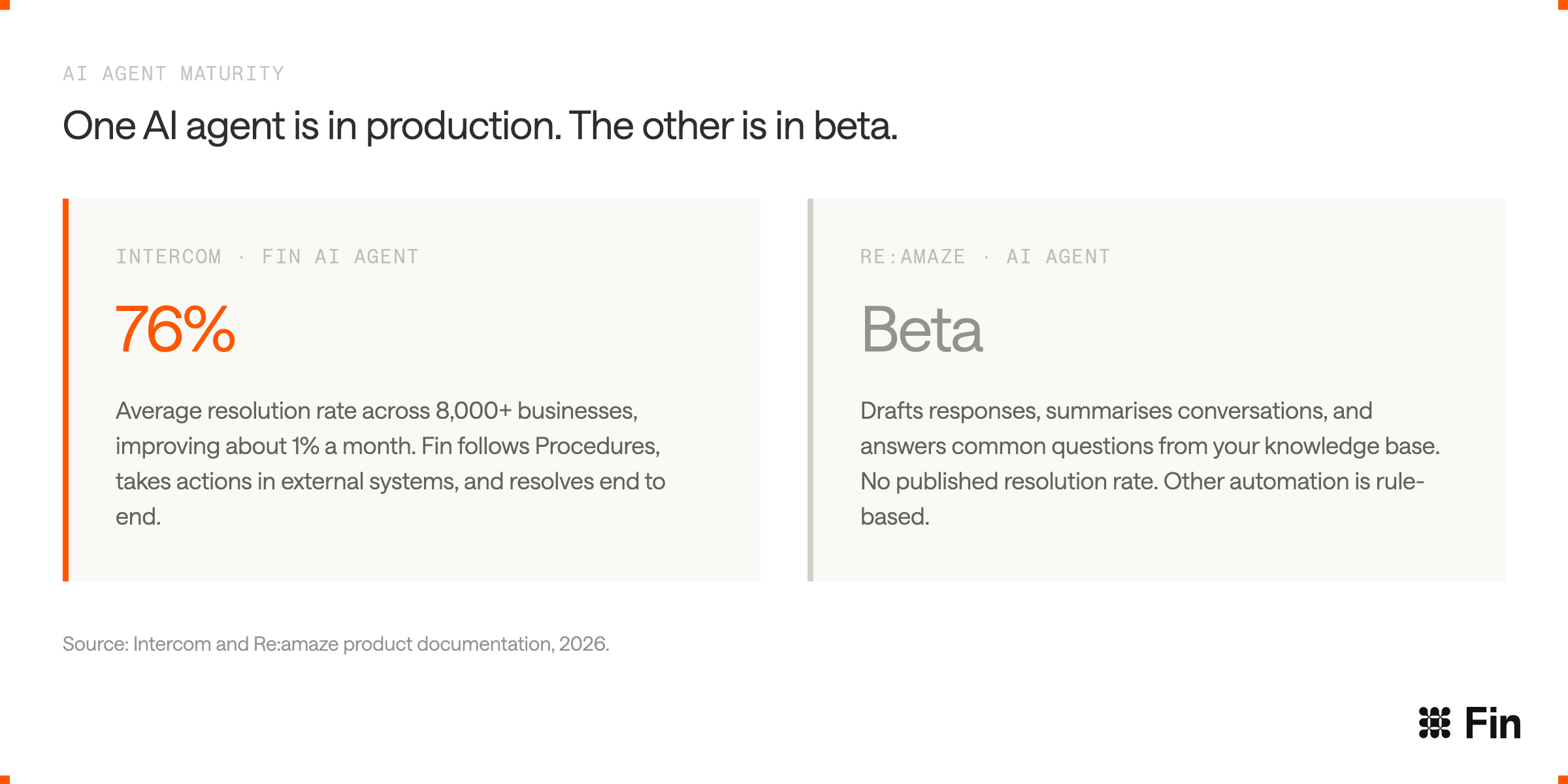
Intercom is built around Fin AI Agent, which uses a proprietary six-layer AI engine with custom-trained retrieval and reranking models. Fin resolves queries autonomously: it reads your knowledge base, follows Procedures you define in natural language, connects to external systems through data connectors, and takes actions like processing refunds or looking up order status. The average resolution rate across 12,000+ businesses is 76%, and it improves roughly 1% each month.
Fin also handles complex, multi-step workflows. If a customer asks about returning a product and then wants help finding a replacement, Fin manages both in a single conversation. The Fin Flywheel (Train, Test, Deploy, Analyze) gives teams a structured loop for continuous improvement: write Procedures, test them with Simulations, deploy, then use CX Score and Topics Explorer to find what needs fixing.
Re:amaze takes a different approach. Its AI Agent is currently in beta. It can draft responses, summarize conversations, and handle common questions using your knowledge base content. Beyond that, automation comes from rule-based chatbots and workflow macros: if-this-then-that logic for routing, tagging, and canned responses.
For teams that want AI to resolve the majority of incoming volume without human involvement, Intercom is the stronger fit. For teams that prefer a human-led workflow with automation as a supplement, Re:amaze covers the basics.
Pricing
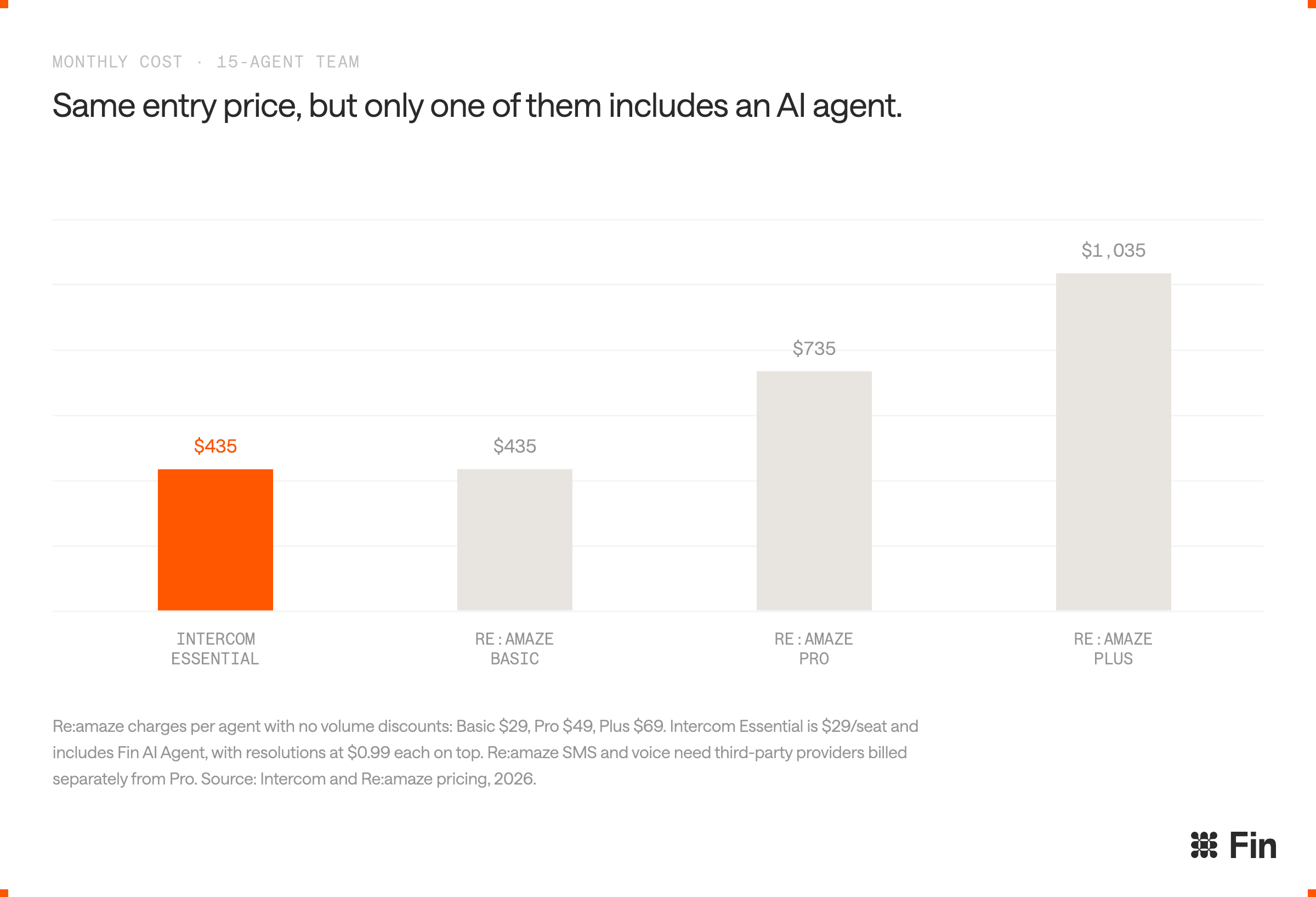
Re:amaze uses straightforward per-agent pricing. The Basic plan starts at $29/agent/month and includes email, chat, social channels, chatbots, and workflow automation. Pro adds multi-brand support, SMS/voice integration (through Twilio or Aircall, billed separately), and advanced reporting at $49/agent/month. Plus adds screensharing, staff performance reporting, satisfaction surveys, and video calls at $69/agent/month. A flat-rate Starter plan costs $59/month for unlimited agents but caps conversations at 500 per month.
Intercom's Essential plan starts at $29/seat/month and includes Fin AI Agent, the Messenger, shared inbox, ticketing, and a public help center. Advanced is $85/seat/month. Expert is $132/seat/month. Fin AI Agent is usage-based at $0.99 per resolution on top of the seat price. You only pay when Fin actually resolves a conversation.
The math depends on your volume and team size. A five-agent team on Re:amaze Basic pays $145/month with no AI resolution capability. The same team on Intercom Essential pays $145/month in seat costs, plus $0.99 for each conversation Fin resolves. If Fin resolves 500 conversations that month, that adds $495, but it also means 500 fewer conversations your human agents need to handle.
At scale, the economics shift. Re:amaze's per-agent cost grows linearly with every hire, with no volume discounts. Intercom's Fin cost grows with resolution volume, but each resolution represents work removed from your team's plate. The question is whether AI resolution saves more in agent time and hiring than it costs in per-resolution fees.
Channels
Both platforms cover the core channels: email, live chat, and social media (Facebook, Instagram, Twitter).
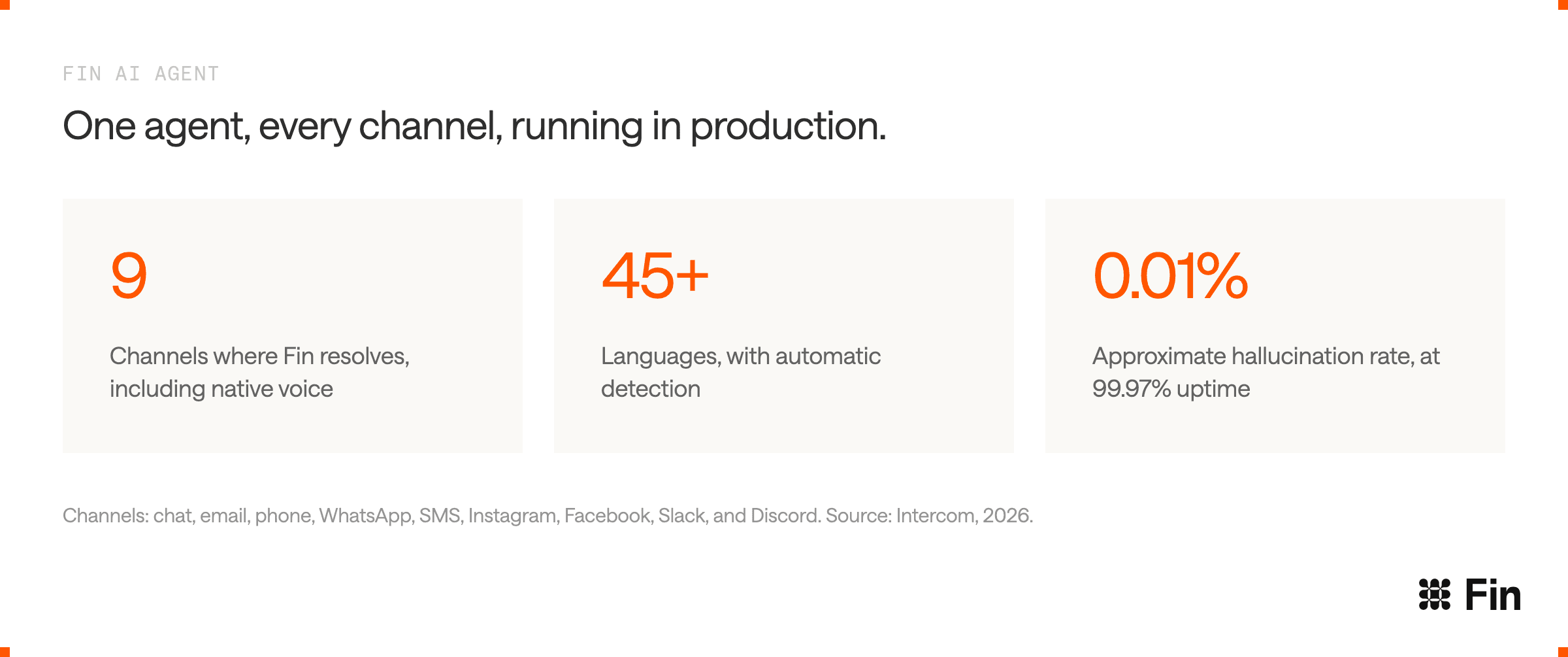
Intercom extends further. Fin operates across voice (with Fin Voice, a native AI voice agent), WhatsApp, SMS, Slack, Discord, and API. The same AI, knowledge base, and Procedures apply across every channel. A customer who calls gets the same quality of resolution as one who messages on chat.
Re:amaze includes email, chat, social, SMS, and VoIP. SMS and voice require third-party providers (Twilio for SMS, Aircall for voice) starting on the Pro plan. The per-message and per-minute costs from those providers stack on top of your Re:amaze subscription.
For teams that need AI-powered phone support or operate across Slack communities and messaging apps, Intercom covers more ground. For teams whose volume is concentrated in email, chat, and social, Re:amaze handles those channels well.
Ecommerce integrations
Re:amaze was built for ecommerce. It integrates with Shopify, BigCommerce, WooCommerce, and Magento. Agents can see order history, process refunds, and check shipping status directly within conversations. The platform supports multi-brand management on Pro and Plus plans, letting teams run several storefronts from a single account.
Intercom is a certified Shopify Plus Technology Partner. The Shopify integration syncs your full catalog (products, variants, pricing, availability), connects order data, and lets agents perform order actions from the inbox. Fin for Ecommerce goes further: it acts as an AI shopping assistant, guiding customers through product discovery, recommending products, comparing options, and moving shoppers toward checkout, all within the same conversation where it handles support.
"The handoff between support and sales is so smooth I can't tell the difference without checking the filters. Fin talks policy, sells products, and references our mattress break-in period all in one conversation." - Kurt Dwiggins, Customer Experience Manager, Avocado Green Mattress
Re:amaze's breadth across Shopify, BigCommerce, WooCommerce, and Magento is an advantage for merchants on non-Shopify platforms. Intercom's Shopify integration is deeper, and Fin for Ecommerce adds a revenue-generating dimension that Re:amaze does not offer.
Helpdesk and inbox
Both platforms provide a shared inbox where teams collaborate on customer conversations with assignments, notes, and internal threads.
Re:amaze keeps things simple. Workflows use macros and if-then rules to route, tag, and auto-respond. The Cues feature sends proactive messages based on visitor behavior. A live dashboard shows who is browsing your site in real time. On Plus, the Peek feature lets agents see what visitors are typing before they send. These are practical tools for teams that want visibility into customer activity without complexity.
Intercom's helpdesk includes a visual workflow builder, SLA management, round-robin assignment, and Copilot, an AI assistant that helps human agents draft replies, search content, and summarize conversations. Agents using Copilot close 31% more conversations daily. The platform also offers product tours, tooltips, and proactive messaging for onboarding and engagement, capabilities Re:amaze does not have.
Knowledge base
Re:amaze includes a built-in FAQ and help center system. Articles can be organized by topic and displayed within the chat widget or on a hosted page. The editor is functional but limited: it does not support inline image uploads (you must link to externally hosted images), and customization options are basic compared to dedicated tools.
Intercom's Knowledge Hub supports public and internal articles, PDFs, URLs, and snippets. Content Targeting controls which content Fin uses for different audiences. Operator, an AI agent for your team, can identify content gaps, draft new articles, and update existing ones when your product changes. The knowledge base is both a self-service resource for customers and the primary fuel for Fin's AI resolution.
Reporting and insights
Re:amaze provides reporting on conversation volume, response times, resolution rates, and agent performance. Managers can filter by channel or agent. Automation reports show how much volume is handled by bots versus humans. These cover the fundamentals for a small to mid-sized team.
Intercom's reporting goes deeper. CX Score evaluates every conversation automatically, covering 100% of interactions without requiring surveys. Topics Explorer groups conversations into themes to identify emerging issues. AI-powered Suggestions recommend specific content updates and configuration changes. Custom reports, dashboards, and drill-down capabilities let teams connect support performance to business outcomes.
Security and compliance
Intercom holds SOC 2 Type II, ISO 27001, ISO 42001 (AI governance), and supports HIPAA compliance. Fin's hallucination rate is approximately 0.01%, supported by proprietary retrieval models purpose-built for customer service. Uptime is 99.97%.
Re:amaze does not publicly document comparable certifications. For teams in regulated industries or enterprises with strict compliance requirements, this is a meaningful gap.
Who Re:amaze is built for
Re:amaze fits small ecommerce teams (two to ten agents) that need a multichannel shared inbox with solid Shopify, BigCommerce, or WooCommerce integration. The pricing is competitive at this scale, especially the $59/month Starter plan for teams with low conversation volume. If your priority is a straightforward helpdesk with manual workflows and you do not need AI-driven resolution, Re:amaze handles the job.
The platform shows its limits as teams grow. Per-agent pricing scales linearly with no volume discounts. The AI agent is in beta. The knowledge base editor lacks modern features. And there is no AI voice capability, no advanced insights, and no proactive product tours.
Who Intercom is built for
Intercom fits teams that want AI to handle the majority of customer conversations while humans focus on complex, high-value interactions. The platform serves businesses from early-stage startups to enterprises with 100,000+ monthly conversations, across ecommerce, SaaS, fintech, healthcare, and gaming.
Fin AI Agent resolves queries across every channel, including voice. The Intercom helpdesk gives human agents the tools they need when they step in. And because everything runs on a single platform, the AI learns from human conversations and humans benefit from AI assistance, creating a continuous improvement loop that standalone helpdesks and bolt-on AI tools cannot match.
"It's not magic. If you invest in understanding, adoption, and great content, AI performance takes off." - Yamine Gluchow, VP of Information Systems, Lightspeed Commerce
How Intercom handles the transition from a traditional helpdesk
If you are currently on Re:amaze or a similar helpdesk and considering the move to AI-first support, the path is straightforward.
Fin works with your existing knowledge base content from day one. Connect your help center, configure Procedures for complex workflows, test with Simulations, and deploy. The Blueprint framework provides a step-by-step guide for launching, scaling, and transforming your support operation with AI.
For ecommerce teams on Shopify, Fin for Ecommerce connects to your store in minutes. It syncs your catalog, drafts Procedures for common support workflows, and is ready to handle both support and shopping assistance before your next peak season.
Intercom offers a 14-day free trial. Start your trial or view a demo to see the difference.
Frequently asked questions
Is Re:amaze or Intercom better for small ecommerce teams?
Re:amaze is a solid choice for small ecommerce teams (two to five agents) that want a shared inbox with Shopify, BigCommerce, or WooCommerce integration and do not need AI-driven resolution. Intercom is the better fit if you want an AI agent to resolve the majority of queries automatically, even with a small team. Fin AI Agent is available on all Intercom plans.
How does Re:amaze's AI compare to Fin AI Agent?
Re:amaze's AI Agent is in beta. It can draft responses and handle common questions using knowledge base content. Fin AI Agent is a production-grade AI with a 76% average resolution rate across 12,000+ businesses, powered by a proprietary six-layer AI engine. Fin handles complex multi-step workflows, takes actions in external systems, and operates across every channel including voice.
Can I use Intercom with Shopify, BigCommerce, or WooCommerce?
Intercom integrates natively with Shopify as a certified Shopify Plus Technology Partner. The integration syncs catalog, order, and customer data in real time. BigCommerce and WooCommerce are supported through Intercom's API and integration ecosystem. Re:amaze offers direct integrations with all four platforms (Shopify, BigCommerce, WooCommerce, and Magento).
Which platform is more affordable as my team grows?
Re:amaze charges per agent with no volume discounts: a 15-agent team on the Plus plan pays $1,035/month. Intercom charges per seat plus $0.99 per Fin resolution. As Fin resolves more conversations, you need fewer agents to handle the remaining volume. At scale, the per-resolution model often costs less than adding headcount.
Does Intercom offer AI-powered phone support?
Yes. Fin Voice is a native AI voice agent that resolves customer queries over the phone using the same knowledge base, Procedures, and data connectors as chat and email. Re:amaze offers VoIP integration through third-party providers (Aircall, Twilio) on Pro and Plus plans, but there is no AI resolution on voice calls.
Can I migrate from Re:amaze to Intercom?
Yes. Intercom supports data migration from other helpdesks, and the platform is designed for fast deployment. Teams with existing knowledge base content can connect it to Fin and begin testing within hours. Intercom's professional services team can assist with more complex migrations.
Scale ecommerce support beyond the inbox
See how Intercom uses AI to resolve product, order, account, and post-purchase requests across systems while reducing manual workload as customer demand grows.
Start a free trial | View demos