Announcing the 2026 AI Sentiment Report: How end users feel about AI Agents
We asked over 1,000 end users how they felt about interacting with AI Agents, how capable they think they are, and how much they trust them. Here are our findings.
Businesses are earning trust in AI by accident. It should be earned on purpose.
People become more accepting of AI the more they use it, but acceptance that’s built on mere exposure is passive. Businesses may benefit, but they’ve often done nothing to earn it.
Our latest research shows people’s sentiment toward AI is higher than it was last year, and they believe the technology’s become more capable. Trust is also rising, but it’s more conditional.
Download the 2026 AI Sentiment Report →
For most people, how much they’re willing to trust AI depends on what they’re asking it to do. For queries that are nuanced or emotionally charged, full trust still needs to be earned.
But we also found that trust isn’t fixed. Businesses can design customer experiences that earn user trust. In The 2026 AI Sentiment Report, we explore how.
Here’s a look at our findings.
Sentiment is warming, but trust is still conditional
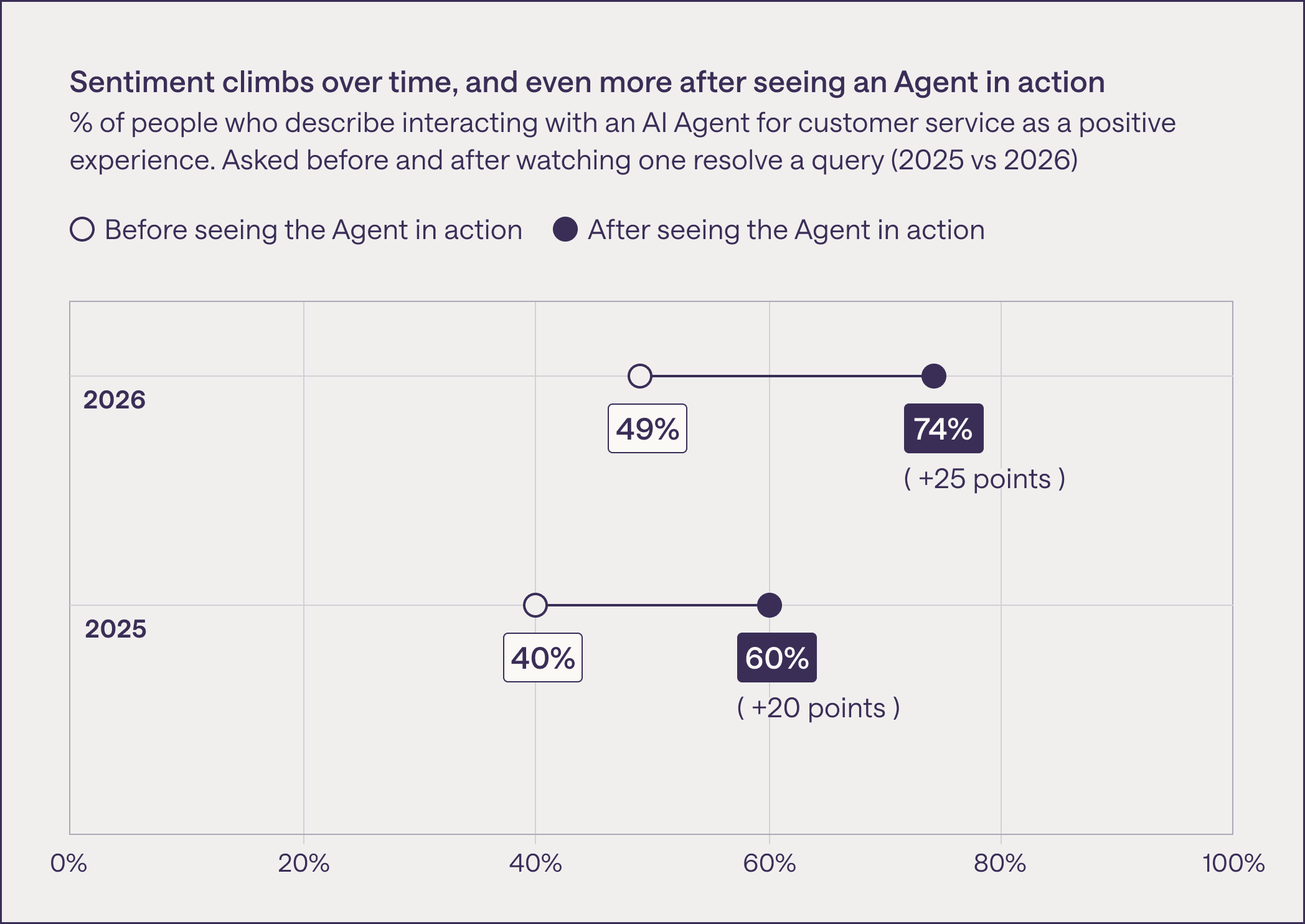
End users are feeling more positive than last year about interacting with an AI Agent for customer service.
Forty-nine percent of people described having positive overall experiences with AI – up nine percentage points from 2025.
Halfway through our survey, we showed each respondent a short video of an AI Agent resolving a real customer query, then asked the same set of questions a second time. This let us measure both how people feel about AI in the abstract, and how that changes when they watch it work.
Once they saw the AI Agent in action resolving a query, the number of people who felt positively about it jumped to 74%.
But feeling good about the technology isn’t the same as trusting it, and people’s trust is still conditional.
Complexity is where trust needs to be earned, but “complex” can mean different things
Fifty-four percent of end users say they’d trust AI to handle simple or routine issues, but not complex ones.
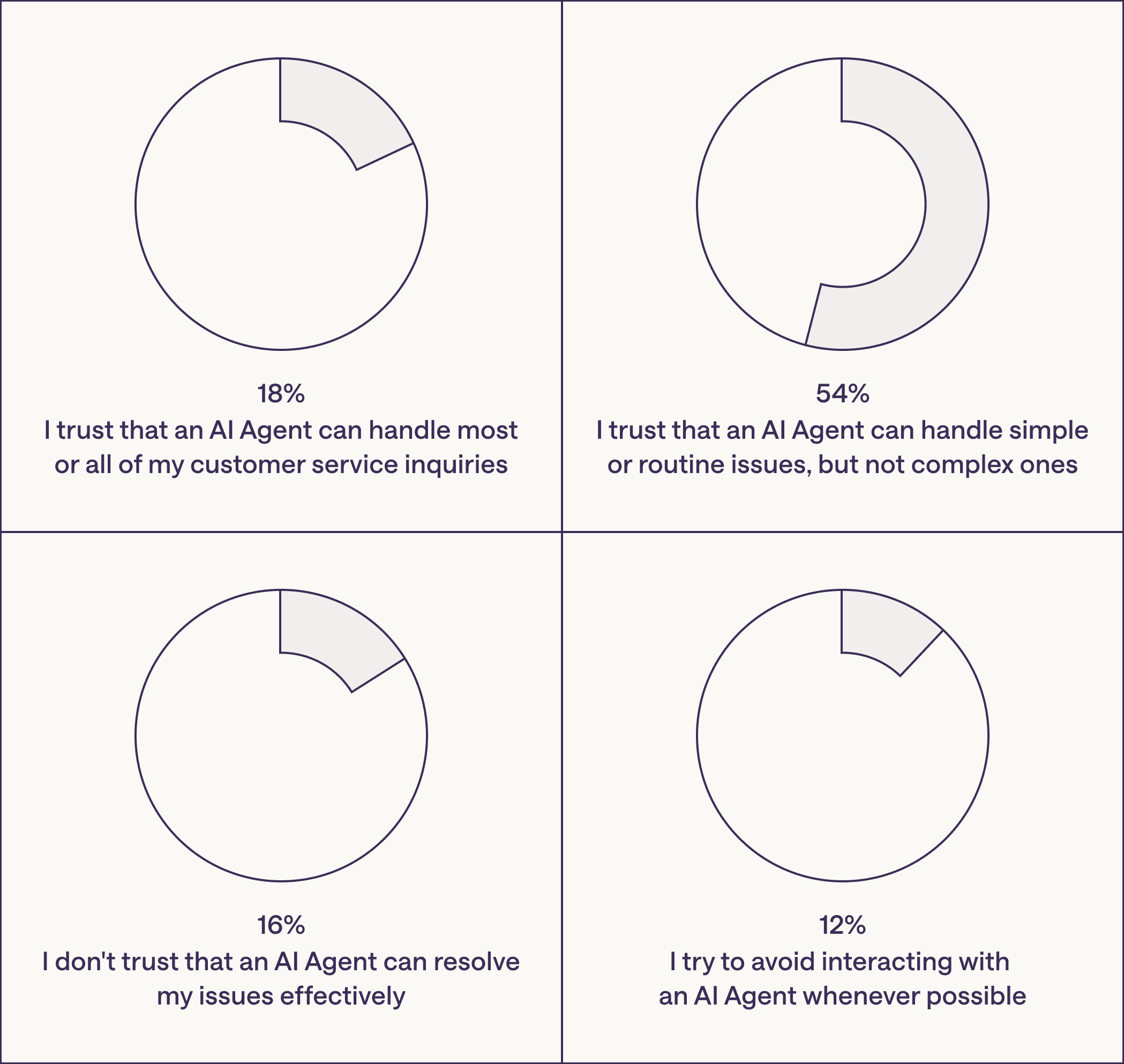
But “complex” can mean different things. Many people have concerns about whether AI can apply discretion in the same way a human can, what happens to their personal information once they hand it over to an Agent, and whether the Agent can reliably keep track of everything they’ve shared with it across a multi-part conversation.
What’s interesting is that end users worry more about how AI will resolve their problem, not whether it’s capable of providing them with an accurate answer.
People worry AI won’t own its mistakes or use judgment
When we dug deeper into why people wouldn’t trust an Agent, they had two distinct concerns about its behavior – whether it can take accountability for its actions, and if it can exercise the same judgment and flexibility as humans when handling more nuanced problems.
End users have the perception that AI Agents operate in a silo. They worry that whatever happens in a conversation stays there, with no human team managing or watching over it in the background. They’re looking for reassurance that the Agent is accountable to someone for its answers, decisions, or mistakes, and that a human is easily accessible if they need one.
They also assume that AI can’t flex and use judgment in the way humans can. They worry that an Agent will always stick to policy and process, even when the situation calls for an exception.
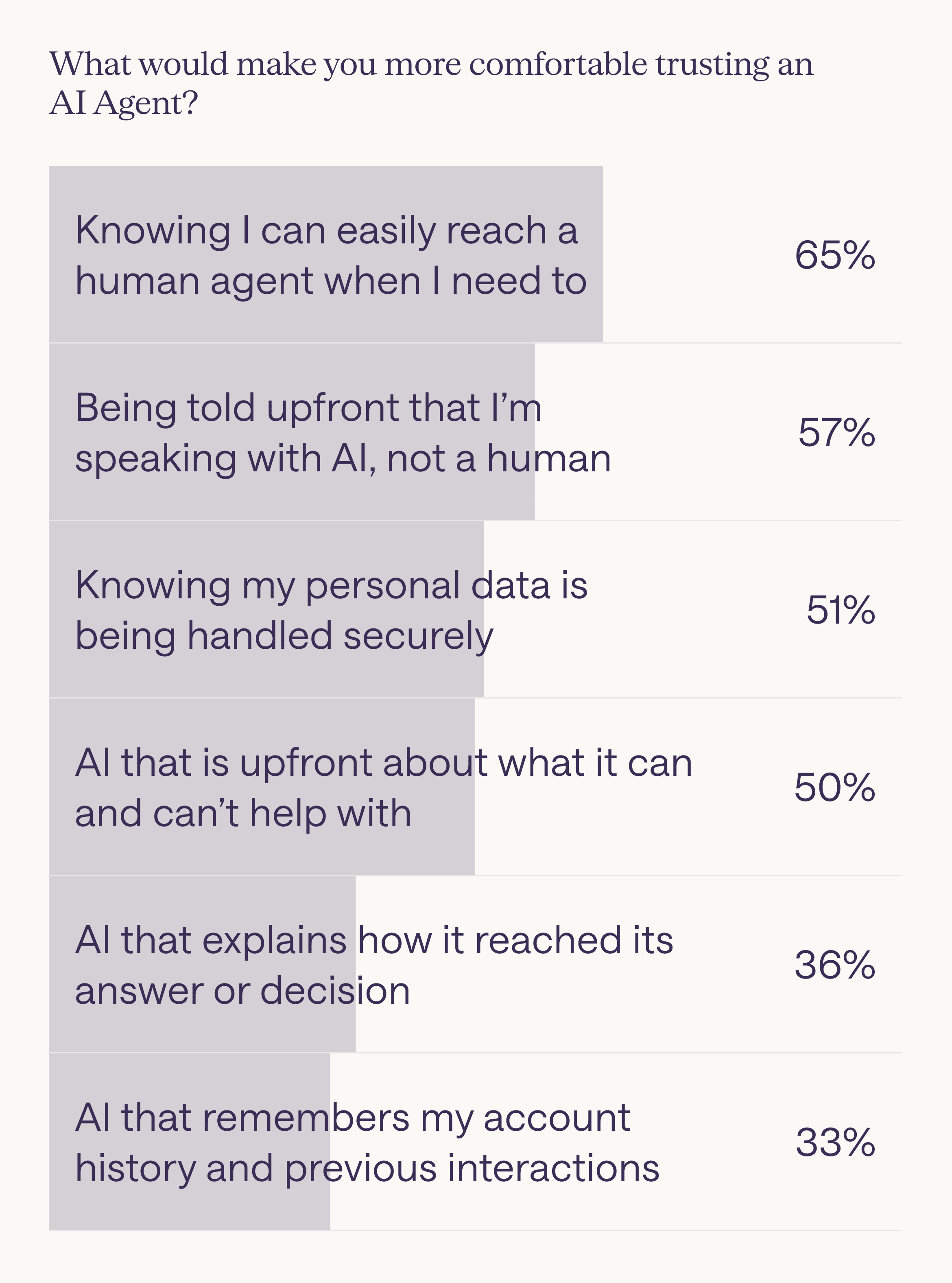
When asked what would make them feel more comfortable trusting an Agent to resolve their queries, end users’ top two choices were “easy escalation to a human when needed” and “being told upfront [they’re] interacting with AI, not a human.”
Every channel comes with its own expectations of trust
Trust in AI varies from channel to channel. People are most willing to fully trust AI to resolve queries when engaging with it over chat – the channel they are most familiar with for AI-powered support interactions. They’re least willing to fully trust it on social channels, where they’re more accustomed to interacting directly with humans.
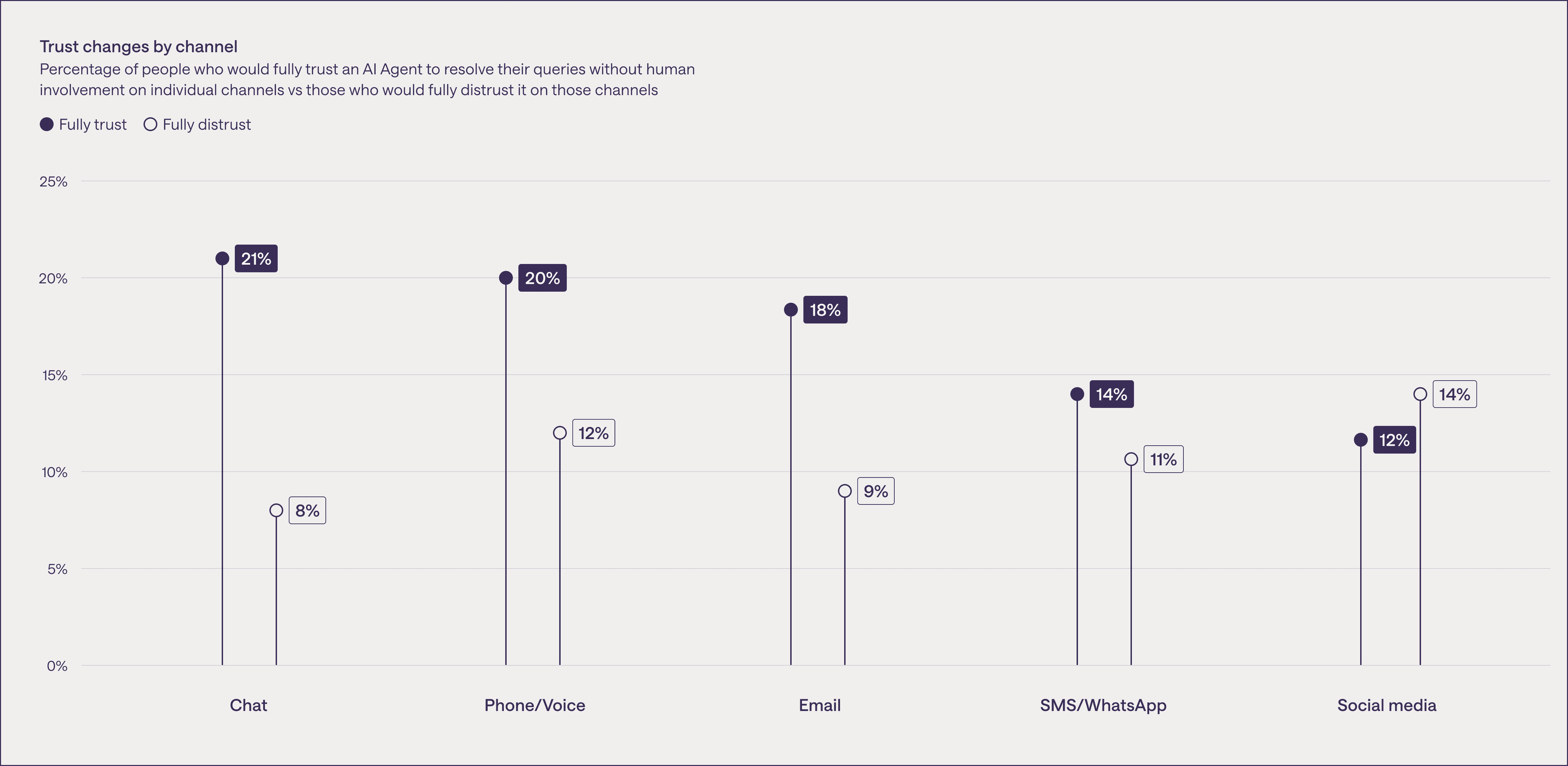
Phone is the most polarizing channel of all. The reasons for this are influenced by how comfortable people are with AI. Some end users who never use AI find talking to an Agent frustrating, while others who use the technology daily or almost daily often prefer it when an Agent picks up their call.
Beyond support, people ask ‘whose side is AI on?’
Extending AI to other use cases like shopping introduces a new question of trust: “whose side is it on?”
Some end users have concerns that AI shopping assistants prioritize the business’s financial goals over what’s best suited to their needs. As one respondent said: “Automatically, I am under the assumption that the AI helping me is programmed to consider the company’s bottom line and not what is in my best interest.” Another raised concerns that they might only be directed towards certain products: “My biggest hesitation is that the AI Agent may be programmed to be biased toward certain products and purchasing decisions.”
This concern over where the Agent’s allegiance lies means businesses have to work to reassure people that the technology is on their side.
Treat trust as a design problem
The through-line of this research is that while end users’ sentiment toward AI is warming and they trust it more than ever before, that trust is still conditional.
But trust can be built, and the levers to do it are all in your control. In this year’s report, we take a closer look at how to use each lever to design for end-user trust.